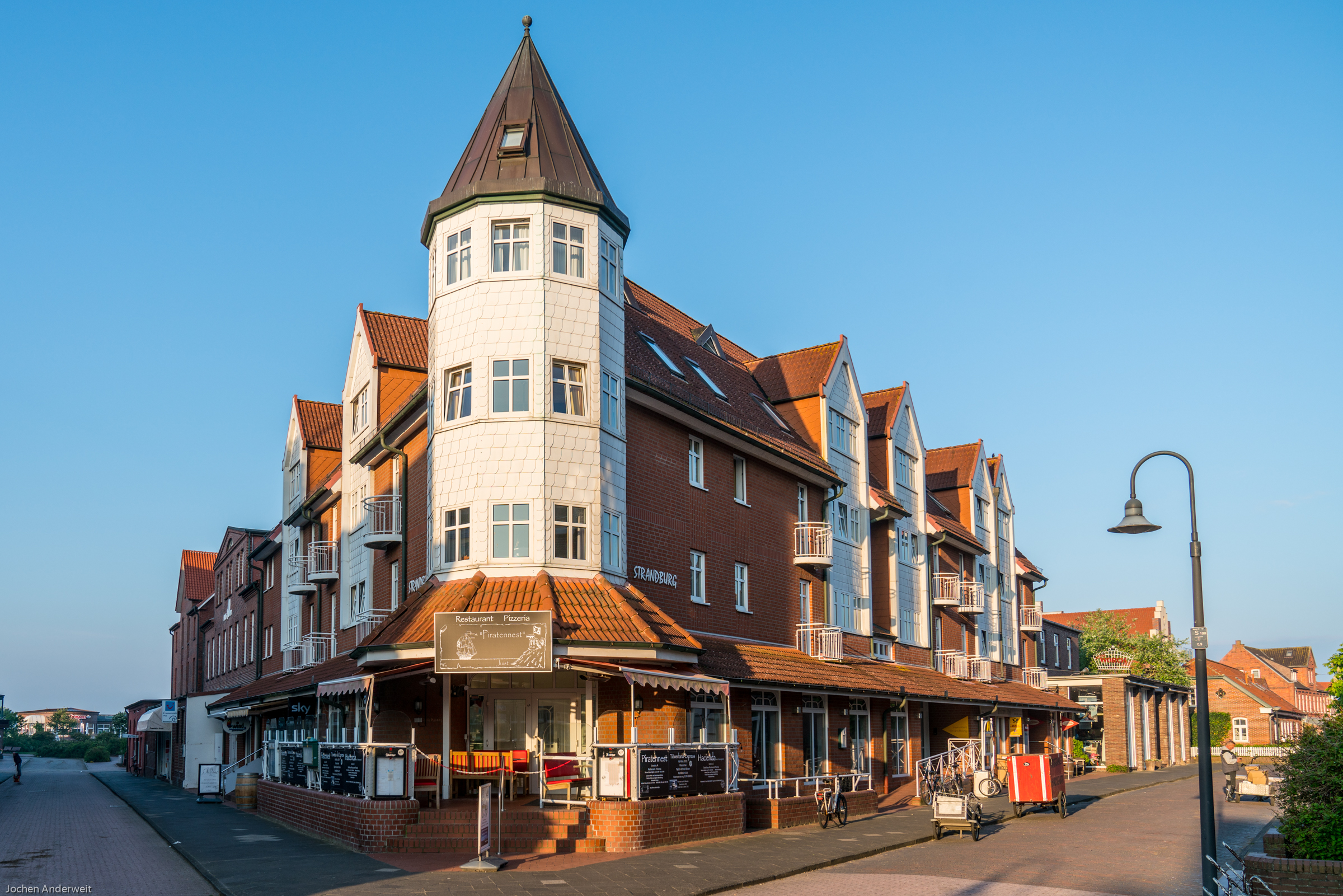
One neighbourhood on Barcelona's grid carries 52 hotel buildings in our data, and a photograph of every single one. No other label in Spain comes close: the next densest holds 17. But the number needs two corrections before it means anything — 52 is a neighbourhood, not the Eixample district, and the pictures are not the work of an institution. Thirty-nine of the 52 were taken by one volunteer with a camera.
Where these numbers come from. All 1,130 Spanish rows come from Wikidata, which catalogues buildings. Each row carries a name, a coordinate pair, a district or city label, and the filename of one image on Wikimedia Commons. There is no address, no telephone, no star grade, no description and no price on any Spanish row. Licences, authors and dates for all 52 images in the Dreta de l'Eixample were read from the Commons API on 17 August 2026. Queried the same day.
Fifty-two is a neighbourhood, not a district
Barcelona's Eixample is a district, one of ten, and it contains six barris. Our data labels rows with the barri, not the district — and the 52 all belong to one of them, the Dreta de l'Eixample, the right-hand half either side of Passeig de Gràcia. Add the other five barris and the Eixample district holds 74 hotel buildings in total, which is the figure to use if someone asks about the district.
That is where the honest count stops, because a further 112 rows are labelled only “Barcelona”, with no barri at all. Some of those certainly stand in the Eixample — the grid covers a large share of the city centre — but nothing in our data says which, and we hold no boundary file to decide it. Drawing a rectangle over the Eixample and counting what falls inside does not work either: the grid is rotated 45 degrees to the compass, so any box tight enough to exclude the Gothic Quarter also cuts off half of Passeig de Gràcia. 74 is a floor. The true Eixample number is somewhere between 74 and 186, and our data cannot narrow it.
The one thing that could have wrecked the count, checked
Barcelona appears in this data both as a city and as its neighbourhoods, which raises an obvious risk: that the 112 rows labelled “Barcelona” are the same buildings as the barri rows, filed twice, and that adding them would double-count. We tested it. Across the whole Barcelona coordinate box there are 242 rows, 242 distinct names and 242 distinct coordinate pairs — not one collision. The city-labelled rows and the barri-labelled rows are different buildings. The labels are inconsistent; the inventory is not duplicated.
These are working hotels, not monuments
This is where the Eixample set parts company with the rest of our Wikidata holdings. Miami Beach's 287 buildings are an archive of mid-century postcards, many of them for hotels that no longer exist. The Dreta de l'Eixample reads like a current trade directory: Claris Hotel & Spa GL, Cotton House Hotel, Autograph Collection, Hotel Casa Bonay, the Mandarin Oriental, the Monument, Ohla Eixample, five H10 properties, three Room Mates, two NH Collections, an Iberostar, an Occidental. Forty-six of the 52 image files are named exactly after the hotel — Alma Barcelona GL.jpg, Gran Hotel Havana.jpg — which is how a photographer names a file when photographing a business, not a monument.
- Only five of the 52 carry a website. As in every Wikidata country we hold, that field records editorial attention rather than whether a business is trading. Do not read the other 47 as closed.
- A few rows are named for the building rather than the operator. Catalonia Eixample 1864 is photographed under the file Cases Cerdà, the block it occupies, and El Palace Hotel Barcelona under a file named for the Diana fountain on Gran Via that stands outside it. The name in our data and the subject of the picture are not always the same thing.
- Not all 52 are hotels in the ordinary sense. The list includes apartment operators — Apartments Sixtyfour, Midtown Apartments, Mayerling Abamita — and a university hall of residence. Wikidata's category is broad, and we have not narrowed it.
Six of the fifty-two
Six of the 52 buildings labelled Dreta de l'Eixample. Each card shows the Commons photograph attached to the Wikidata record — recent photographs, unlike most of our American set. We hold no address, no telephone, no star grade, no price and no booking link for any of them, and these cards are records rather than offers.
El Palace Hotel Barcelona
Dreta de l'Eixample
Preis auf Anfrage

Hotel Majestic
Dreta de l'Eixample
Preis auf Anfrage

Claris Hotel & Spa GL
Dreta de l'Eixample
Preis auf Anfrage

Cotton House Hotel, Autograph Collection
Dreta de l'Eixample
Preis auf Anfrage

Hotel Casa Bonay
Dreta de l'Eixample
Preis auf Anfrage

Catalonia Eixample 1864
Dreta de l'Eixample
Preis auf Anfrage
One volunteer took three-quarters of the pictures
We read the author of all 52 images. Thirty-nine of them were taken by a single Wikimedia contributor signing as Pere prlpz, and eight more by a second, Cataleirxs. Two people account for 47 of the 52. The dated files run from 2006 to 2026 with a median year of 2024 — this is a recent survey, still in progress, and one of the pictures was taken this year.
Set that beside the same measurement in Prague, where one contributor took 41 of a 60-file sample, and a pattern emerges that is worth stating plainly: the countries in our catalogue that look comprehensively photographed are the ones where a single person decided to photograph them. The coverage is not institutional. It is a handful of individuals, and it stops precisely where their interest stopped. That is why the Dreta de l'Eixample has 52 pictures and the Nova Esquerra, an equally large neighbourhood on the other side of the same grid, has three.
How the hotels sit on Cerdà's grid
Looking outward from the Dreta to its neighbours shows how sharply concentrated the 52 are. The Eixample was laid out by Ildefons Cerdà from 1860 as a uniform grid with chamfered corners, and it is uniform in almost everything except this.
The Dreta holds three times as many as the Gothic Quarter and seventeen times as many as the Nova Esquerra across the road. Some of that is real — Passeig de Gràcia is where the grand hotels went, and the barri contains the modernista blocks that made the address desirable — and some of it is simply where a photographer walked. We can measure the gap. We cannot tell you how much of it is Barcelona and how much of it is Wikidata, and anyone who tells you otherwise is guessing.
Fifty-two photographed hotels in one neighbourhood is a real finding about a dataset. It is only a finding about Barcelona if you can show the camera went everywhere else too, and here it did not.
What we don't know
- Whether any of these buildings still trades, or trades under the name we hold. Wikidata catalogues buildings, and hotel operators change more often than buildings do. We hold no operating-status field and only five websites across the 52.
- No prices, no star grades, no room counts, no ratings, no reviews. Those columns are empty on all 1,130 Spanish rows, as on almost our whole catalogue — we hold booking links for 13 properties out of 132,375. Nothing on this page is bookable through us.
- Where 206 Spanish rows actually are. They carry the city value “Unknown”, 18% of the country. Four of them fall inside the Barcelona box; the rest could be anywhere, and every Spanish geography in this article is a floor because of them.
- Which of the 112 “Barcelona” rows are in the Eixample. This is the single largest gap on the page. It is why the headline is 52 and not a larger, rounder, less defensible number.
- Anything about the architecture of an individual building. There is no style, architect or year field on any Spanish row. Cerdà, the grid and the modernista context are general knowledge, cited here for orientation and not derived from our data.
- We have not visited any of them. Everything above is a query result and an image licence read from an API.
Sources
Building records from Wikidata, metadata released under CC0 1.0; the photographs are separately licensed and none of these is public domain. Image licences, authors and dates read from the Wikimedia Commons API for all 52 Dreta de l'Eixample files on 17 August 2026. Hero image: El Palace Hotel on Gran Via with the Diana fountain, photographed 17 July 2013 by Jordiferrer, CC BY-SA 3.0, via Wikimedia Commons. Counts: 1,130 Spanish rows held, 1,104 with a picture, 242 inside the Barcelona coordinate box between 41.32°N–41.47°N and 2.05°E–2.23°E.
More from the same catalogue
- Somebody photographed Prague's hotels address by address — the same one-volunteer pattern, and filenames that reconstruct the addresses.
- Miami Beach has 287 hotel buildings on record, and the pictures are postcards — what this dataset looks like when the photographs are eighty years old.
- Mont Ventoux by bike: where to stay on each of the three roads — the opposite problem: real facts, no pictures at all.
- Every Spanish property we hold — the destination page behind these counts.