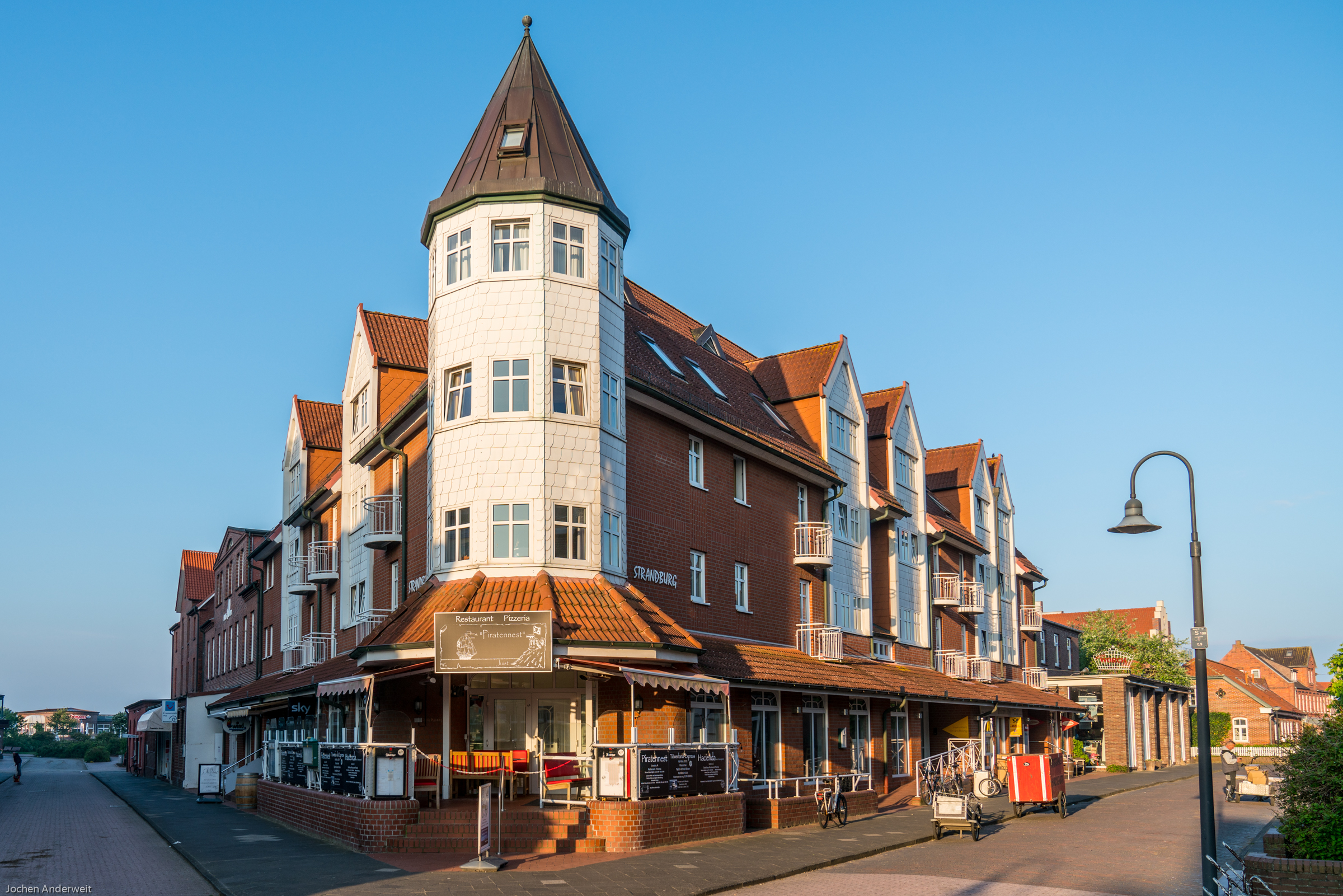
In one rectangle of the English south-west we hold 673 accommodation records, and 643 of them come with a photograph. That is a 96% picture rate — the best of any British region in our catalogue. It is also, measured any other way, the emptiest set of records we have: no star rating, no telephone number, no facility list, no address and no description on a single one of the 673. This article is what an honest picture-led guide looks like, and the first honest thing to say is what the rectangle is.
Where these numbers come from. These records come from Wikidata, the structured-data sibling of Wikipedia, whose hotel entries are building records rather than business listings. Their metadata is CC0; their photographs come from Wikimedia Commons and are licensed individually. Across the whole United Kingdom we hold 6,748 such records, 6,259 of them photographed — and zero telephone numbers, zero star ratings and zero amenity records nationally, not just here. Queried 17 August 2026.
The rectangle is not a county
There is no county field in this data, so the region had to be drawn as a bounding box: latitude 49.8 to 51.2 north, longitude 6.0 to 2.5 west. That box holds Devon and Cornwall, and it also holds a corner of Dorset and a slice of Somerset. 137 of the 673 records — 20% — sit east of 3.0 degrees west, which is to say outside Devon and Cornwall entirely.
What we hold, and what we do not
Four of those zeros are absolute, not merely sparse. There is no telephone number, no star rating, no amenity and no description on any British record we hold, from any source. So this set cannot tell you whether a place takes dogs, has parking, serves dinner, has a lift, or is open. What it can tell you is that a building exists, roughly where it stands, what it is called, what it looks like, and — one time in five — where its website is.
And nearly half of it is a pub
The word hotel in this dataset is doing a lot of work. Of the 673 names, 253 contain the word Hotel and 303 contain the word Inn without containing Hotel — the Ship Inn, the Church House Inn, the Who’d Have Thought It Inn. A further 35 are somebody’s Arms. This is, in large part, a catalogue of West Country public houses that have rooms or once had them, and it should be read that way rather than as a shortlist of hotels.
Where the 673 are
The geography field is inconsistent and the table shows it. Torbay and City of Plymouth are local-authority areas; Fowey and Totnes are towns; eight records say only Unknown. All 290 distinct place values sit in the same column with nothing to mark which kind each one is, and the 673 records spread across 290 of them — an average of 2.3 records per place. There is no district or neighbourhood field to fall back on, for these or for any British record.
The Royal Clarence problem
Wikidata catalogues buildings, and buildings outlive the businesses inside them. Our Exeter records include Royal Clarence Hotel, which is listed as active, carries a photograph and carries a working web address. It has not been a hotel since 28 October 2016, when it was gutted by a fire that spread from an adjoining building. Restoration began in 2025, is due to finish in December 2027, and will produce apartments with ground-floor commercial space — not a hotel. It had traded since 1769 and was often called England’s oldest hotel.
We found that by checking, not from our data, because there is no operating-status field to check. We cannot tell you how many of the other 672 have closed, changed hands, become flats or burned down. Assume some have. Every property below is worth a look for its architecture; not one of them should be treated as bookable on our word.
Three buildings worth the detour
Burgh Island Hotel on its tidal island off Bigbury, the Jamaica Inn on Bodmin Moor, and the Duke of Cornwall in Plymouth. All three are photographed, all three carry a website, and none of them carries a star rating, a telephone number or a facility list — because no British record in our catalogue does. Check the website before you plan around any of them.


What we don’t know
- Whether any of these still trades. There is no operating-status field, and at least one famous entry has been a shell for ten years. Wikidata records notable buildings, which includes demolished, converted and renamed ones.
- Anything about the rooms. No star rating, no price, no room count, no accessibility, no parking, no dog policy, no dinner. Those fields are empty for every British record we hold, so no British filter on this site can be trusted to mean anything.
- How to telephone. Not one British record carries a phone number. For 146 of the 673 there is a website; for the other 527 there is a name and a map pin, and that is the whole contact story.
- Which county a record is in. There is no county or district field. The split in this article is our bounding box and our longitude cut at 3.0 degrees west, both of which are approximations — the Devon–Dorset border does not run along a line of longitude.
- Whether the picture shows the building today. Commons photographs carry a date and many are more than a decade old. The hero image on this page was taken in July 2009.
- Why coverage is shaped like this. Torbay has 40 records and Newquay has 5. That is a measure of which buildings Wikipedia editors have written about, not of where the hotels are, and it is why no town in the table above should be compared with another on record count.
Sources
Building records from Wikidata under CC0; photographs via Wikimedia Commons, each under its own licence. The Royal Clarence fire and restoration timeline was checked against Wikipedia rather than derived from our data. Retrieved 17 August 2026: 6,748 active British records, 6,259 photographed; 673 inside latitude 49.8 to 51.2 north and longitude 6.0 to 2.5 west, 643 of them photographed, 146 with a website, 137 east of 3.0 degrees west. Hero photograph: Burgh Island Hotel, by Tony Atkin, CC BY-SA 2.0, via Wikimedia Commons, taken 8 July 2009.
More from the same catalogue
- Switzerland’s hotel stars: 60% of the register carries none — the opposite problem, facts without photographs of the ones that matter.
- 854 Japanese hotels, 787 photographs, and a place-name problem — the same Wikidata source, the same silence, a different failure.
- Where to sleep above 2,000 metres in South Tyrol — what a register looks like when it does carry facts.
- Every British property we hold — the destination pages behind these counts.